Tuesday, 14 January 2014

Shoppers Drug Mart Give Beauty Event


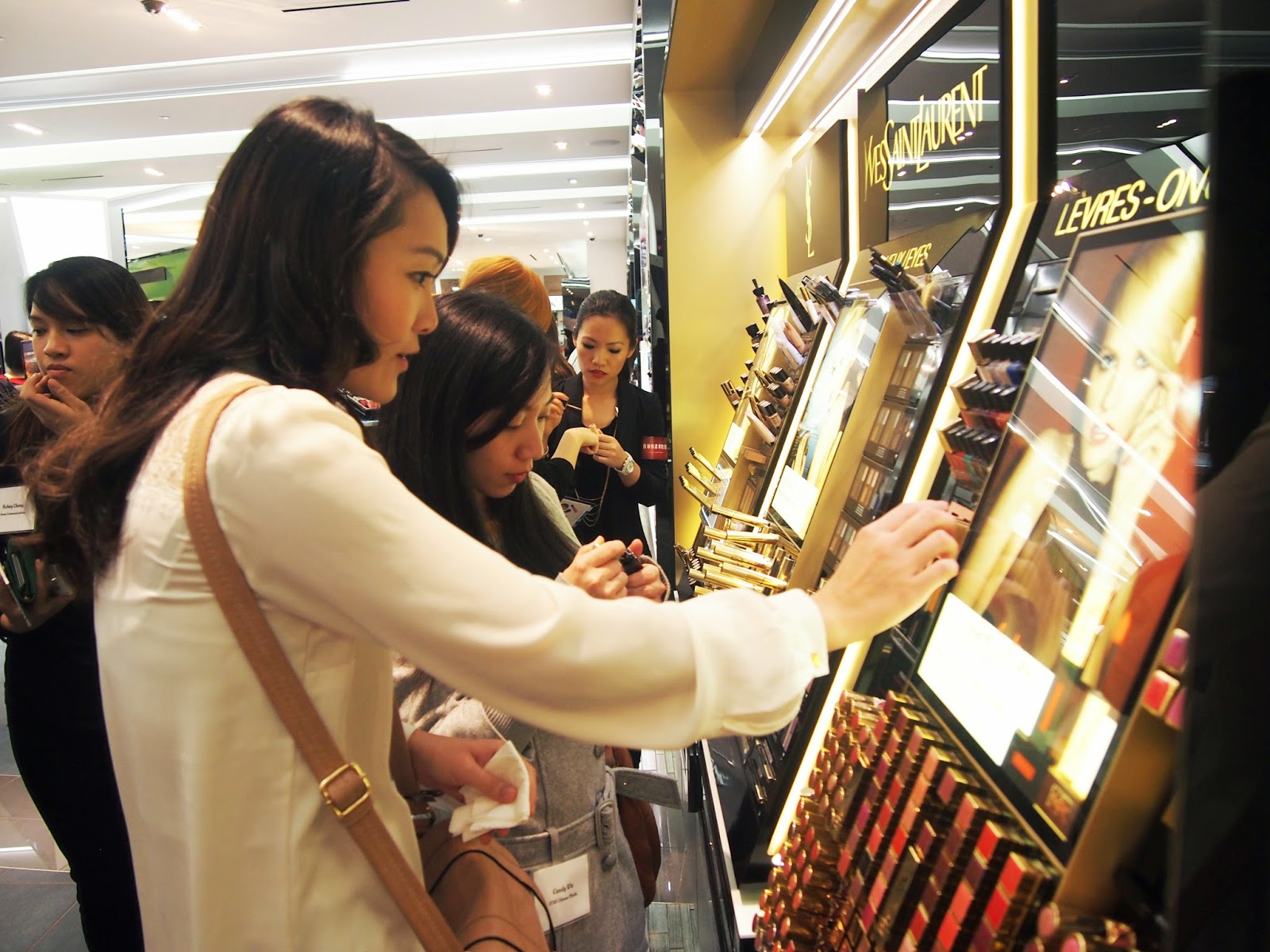
Christmas will always be that time of year with back to back parties. What's more important than preparing for it? Last year on December 8th, Shoppers Drug Mart BeautyBOUTIQUE at Bayview Village partnered with SENSU Communications to host an in-store "GIVE BEAUTY" event, targeted at the Chinese-Canadian community.

Nearly 30 Sina WEIBO beauty bloggers, along with print and broadcast media attended the event and  were given a star-studded experience. Guests were welcomed by setting foot onto the red carpet for a photo against our GIVE BEAUTY backdrop, using photo signs branded with the beautyBOUTIQUE and Shoppers Drug Mart logo. To top off the festive atmosphere, branded cupcakes and refreshments were served to our guests. 


Huang of A1 Chinese Radio, MC of the evening, kicked off the event, and was shortly joined by two beauty advisors from Shoppers Drug Mart, Sarah and Loida, of whom shared their expertise on Canadian winter skincare, including advice on proper skin cleansing techniques and moisturizing products. Tips on how to apply flawless foundation and eye makeup were also explained, followed by two demonstrations - a simple everyday look and an evening glamour look.


Bold is back this season, and Loida assured us that anyone can pull off a smokey eye. For those who like to mix things up a bit, pick a different colour instead of solid black for an added mystic effect. Brown, steel blue and greyish green are safer colours to choose from. For the latest look, try experimenting with different shades like steel grey, olive green, metallic orange and steel blue. If you still prefer the classic smokey eye with black or grey-black eye shadows, try using a colour eyeliner for a sheer look. Our guests had a great time sampling different products as they listened on to beauty experts, all the while taking photos and posting live to their Weibo microblogs.


After the workshop, Weibo beauty bloggers couldn't wait to shop the store for their favourite brands and products that were demonstrated during  the workshop. Beauty representatives from Lancome, YSL, Shiseido, Clarisonic, Chanel, Guerlain and Biotherm were also on-site to offer personal consultations and makeup tips. 


Each guest was presented with a $20 Shoppers Drug Mart gift card and an exclusive offer to receive 20,000 Shoppers Optimum bonus points with a purchase of $125 or more. To wrap up the event, attendees  received a beautyBOUTIQUE™ gift bag, valued at over $225, filled with samples from over 10 luxury cosmetic brands. 


This unique event, targeted at Chinese beauty consumers, is part of Shoppers Drug Mart’s 2013 Holiday Promotion. Other elements in the campaign include print, online, indoor OOH, and consist of a major social component. 

Monday, 22 April 2013

Sensu is Featured in the Marketing Magazine!


I am glad to announce that Sensu was being featured in the marketing magazine at the starting of this month! It is the recognition for our hard work and success, and makes us even more proud of what we do.  The article talked about the acculturation differences of the Chinese compare to the other ethnic groups, characteristics of different ethnic populations in terms of social network adoption, and the importance of providing multi-cultural conversations to enhance the effectiveness of customer engagement.  

Sensu has been using social media and in-language approach to target the Chinese customers for our clients.  Why this approach?  A recent data from Internet World Stats displays of nearly 2 billion internet users estimated in 2010, 82% spoke one of 10 macro-languages, where Chinese is the second most spoken language.  According to the analytics from Environics, it displays that social media adoption is more prevalent for many multicultural clusters compare to the national rate. Based on the April 2012 report from Mckinsey, it also showed that 95% of the Chinese internet users are registered on a social media site.  That gives us a reason to target online social media sites to engage the current and potential customers for our clients.  This way we could also leverage our competencies in tracking and translating the big data into measurable insights for clients’ strategic business planning purposes.

A real business case mentioned by the marketing magazine was on the collaboration between Holt Renfrew and Sensu, where the Chinese social media site Weibo was used for the 175 anniversary of Holt Renfrew.  The brand page started as an event based.  It attracted 692 followers in 20 days, and produced an increase of 148% in conversion rate on Weibo between the years of 2010 to 2012. 

According to the research from Brooking Institution Scholar Homi Kharas, the global middle class will double in size by 2030, where Asia will account for 64% of the global middle class.  With the continuous high immigration rate from Asia over the years, these data indicates that the market will only get larger and larger.   This way the best approach in customer engagement needs to be in place to correspond to this market change.  As of the future, we would encourage the brands to go above and beyond to take the approach of understanding your customers, assist them in their preferred languages and embrace new media for the success in the multi-cultural market. 

Thursday, 11 April 2013

Reach Multicultural Consumers Through New Media -- Would You Like to Succeed?

At the end of February, American Marketing Association (Toronto Chapter) hosted a multicultural marketing round-table event. The purpose is to help companies further recognize the potential of the ethnic markets and provide best practices from industry leaders.Here is a video that you can look at, which captures the event and the thoughts of the guests.


The attendees came from four different areas, client, agency, media and research. The panelist group was comprised of marketing experts including Holt Renfrew, Beam Global Canada, and Western Union Canada, where both Holt Renfrew and Beam Global Canada have been working in collaboration with Sensu on targeting the Chinese consumer segment in Canada. 

The panelists each gave examples on how their company successfully utilized strategies to target the ethnic groups.  For instance, Holt Renfrew leveraged the popular Chinese social media platform, Sina Weibo, to engage the potential and existing customers.  Social media content was culturally tailored to ensure resonance with the brand among Weibo users.   The social media pilot campaign, which focused around Holt Renfrew’s 175th anniversary, drew more than 700 followers to the brand page within 20 days.

The presenters highlighted the high purchasing power and potential of the ethnic groups.   The combined population growth of South Asians and Chinese numbered at 27% in the last 10 years. By comparison, the average Canadian population growth staggered at only 5 %, which indicating the multicultural market no longer being a niche.  Bobby Sahni, the founder and president of Multicultural 411 and also a veteran in the field, bringing more than 10 years of experience from leading Rogers’ multicultural marketing strategy, was the moderator of the event.  He encouraged brands to demonstrate cultural sensitivity and mentioned that consumers do have cultural preferences when it comes to shopping behaviours and habits.  His piece of advice is, whether a multi-cultural marketer or just a marketer, it is critical to recognize the importance of cultural influence and integrate it into the business strategy to achieve success.

From Sensu’s perspective, by being a sponsor of this event, it is rewarding to see the increasing interest in multicultural marketing from mainstream marketers.  Authenticity is at the core of Sensu’s philosophy, and in practicing this through all the work we do, we believe it is absolutely critical for brands to embrace new media channels when connecting with Chinese consumers. There are endless opportunities to connect to the multicultural markets through innovation in media channels – take a risk, be bold, be creative and it will pay-off. The companies that are willing to go above and beyond have experienced success.   It may seem like a risk on the onset, but it is a calculated risk that brands can take with the help of experts like Sensu.  In the undeniable reality of diversity in Canada, it is no longer an option for the future development of all organizations that want to achieve success in the consumer market.

Feel free to make a comment and tell us what your thoughts are! 

Wednesday, 20 March 2013

How to Make Better Use of Mobile Apps


Happened to have a conversation with a friend of mine yesterday on the mobile app she downloaded from a luxury brand.  It started off like this, my friend: “Did you know that this brand had a mobile app?” My reply: “That is very interesting! I haven’t checked yet, what’s on it?” My Friend: “Actually, nothing really.  See, they just tell you about their store hours, the locations, the product category that they have.  I was expecting to see some new arrival or promotional information.  This app is boring. I’m just going to delete it.” Hint!  As a brand, have you ever questioned the effectiveness of engaging your customers through mobile strategies?  Or thought of it as a dispensable strategy?

Mobile devices had become the most used electronics for the daily lives of the younger generation.  It is often used for social purposes, information search, and now it has promptly becoming a tool for shopping assistance.  Many companies have started to notice this, and are rushing in to share a piece of the pie.  Yet, there may be a miss understanding on how customers could be best engaged through mobile devices.  According to the recent research studies, the two most common reasons that people use mobile devices are for the convenience and the timely information it provides.  By knowing this, a mobile strategy should be formulated towards these two goals.  When the customers want to be connected to a one stop shop with no time constraints or geographic barriers, the strategy of developing a store directory app will not satisfy the objectives. For example, the Facebook app, it contains Check in, Instagram, Facebook Messenger, and etc. The idea behind it is to go around the user’s life and target the different aspects of their needs.  The fact is the more of user’s time an app consumes the more successful it is at engaging.  

In addition to the functional use of the mobile apps, it also has the feasibility of translating into research data.  As a large corporation, it often can’t go around to everyone and obtain their thoughts.  There certainly won’t always be customers that are like my friend who takes the initiative to tell me what I wanted to hear.   By monitoring the online data such as the social media usage, reviews, and the conversations, the marketer’s thoughts on the previous uncertainties can be better proved.  The path to formulating a customer focused marketing strategy will also be much less time consuming and less costly.  

Wednesday, 13 March 2013

2013 Chinese New Year V.S Canadian Business Practices


Red signs, couplet, zodiac, and the greeting of “Happy Chinese New Year!”  It just makes you feel like you are back in China again!  Other than the local Chinese, people with different cultural backgrounds are getting involved in this festival as well.  This not merely indicates that people are valuing the Chinese culture.  It is also a smart way of creating new business opportunities.  

This year I have encountered some positives and not too positive practices on the cultural tie with the Chinese New Year.  Something interesting to point out is the blog post of Yorkdale Mall.  Yorkdale organized a selection called the “Year of the Snake Fashion Accessories”.  In this selection there are a group of 12 items.  It indicated both the 12 zodiac and the 12 months of the year.  These selections include shoes, glasses, watches, bags and clothing.   No matter what type of accessories one is interest, she would always have an option for it.

A good try but a bad tie would be misspelling  the year of the snake with the year of the dragon. Many people were tweeting about Sobey’s New Year’s flyer on the Chinese Twitter site Weibo.  A few hundred of retweets were generated on the platform followed by some disappointed comments.  It shows the degree of attention this message drove from the Canadian Chinese community. Consider if it was a positive message spreading out to these many audiences, an association would have been created between the customers and the brand, which is likely to translate into sales figures later on.

This year's Chinese new year has already past.  Lesson to learn for the upcoming year is,  in order to succeed in marketing to different ethnic groups, creating the right cultural tie is very important.  And of course, do the right translations as well. 

Tuesday, 27 November 2012

17 Chinese miners dug up Canadian xenophobia

There is no secret that Chinese want to live and work in Canada. In fact, nearly 30,000 Chinese migrated to Canada in 2011. However, while it is a tabooed racist topic to rule out visible minorities from immigration list, unions and some Canadians are more willing to jump into the topics “to protect Canada”, ruling out Chinese from doing business in Canada. In 2011, there are 39,825 foreign workers in primary industry, but unions decided that 300 Chinese miners are simply too many. In addition, several deals of Chinese acquisition of Canadian companies are either blocked or significantly delayed by the Canadian government due to political pressure. Opposition to those deals argues that Chinese purchase of Canadian companies will threaten Canadian security and intellectual properties. While few will openly criticize Chinese Canadians, many are jumped into the fray of China bashing: citing pollution, abuses of human rights, greedy, sly, senseless consumption, etc.
 
While China certainly has a lot of problems, we are talking about real money and real business here. Canadians should be rational and objective to maximize profits and mutual benefits for the good of Canadian public interest and economy. Yet, some Canadians view things very differently when the word “foreign” are replaced by “Chinese”. Somehow, it is a bad deal that Chinese companies buy tar sand mines, while Husky Energy was once owned by the richest man of Hong Kong (still partially owned by his son, Victor Li) and most of tar sand oil will eventually go to the USA, freeing up Gulf supply for East Asia buyers, aka China, at a much cheaper price (largely due to the price difference between Brent Crude Oil Futures (price benchmark of China) and West Texas Intermediate Crude Oil Futures (price benchmark of the USA)). Somehow, it is dangerous for Canadian companies to buy cables and internet equipments from a Chinese company, while most consumer electronics, daily products, toys, apple juice, etc come from China. No one complained when ATI, found by three Chinese Canadians in Markham, Lee Ka Lau, Benny Lau, and Kwok Yuen Ho, are sold to an American company in Sunnyvale, California, AMD, which almost ended Markham high-tech growth overnight. Now, no Canadians worry the lost of intellectual property to China when AMD graphic cards are quietly moved to made in China instead of Canada. Like all good stories, we love to have an antagonist, but crying wolves will just make us look stupid.

Drastic changes to make no change

After months of delay and numerous typhoons from political rumour mills, Xi Jinping, the latest Chinese top leader, has succeeded the presidency with new the military and executive wings. With over 70% turnover rate in both the Central Military Commission and the Executive Committee of the State Council, evidences suggest the internal differences were finally set aside and the settlement was set to make everyone happy (at least, all sides could find quiet compromises.) Aside from normal rhetoric, Xi assures continuity and respect to the previous leaders and emphasis on better the lives of ordinary Chinese. That meant no dramatic u-turn of the macroeconomic policies of suppressing inflation, increasing minimum wages& labour benefits, and achieving both goals through gradual Renminbi appreciation against the USD. With dramatic solutions to the political infighting, the 18th National Congress of the Communist Party of China paves the way to stronger conservatism and patriotism. A new team with new leaders may need more time to act on an economy that shows signs of slowing down. Wealthy Chinese Canadians tend to have over sea assets and businesses in China. The continuation of Renminbi appreciation and suppression of inflation could increase their purchasing power in Canada. Recently, Chinese companies and business owners show signs of increasing interest in investment and migration to Canada. While the leadership swap may be bad news for those who want to seek business opportunities in China, it can be positive news for Canadian market.