SENSU Communications was invited to Shopper Marketing Forum on March 3 & 4 this year, an intimate round table discussion where marketing experts and strategists share their experiences in the field.
As a multicultural advertising agency, we learned a great deal from Mr. Robin Brown, Senior Vice President of Environics Research Group. Consumer spending growth is increasing significantly every year, given that over 250,000 immigrants and temporary foreign workers arrive in Canada each year. These new consumers remind marketers the necessity of a cross-cultural shopper marketing strategy, and this is what SENSU Communications strives to achieve. Mr. Brown discussed the challenges and opportunities in reaching consumers from these diverse cultures and communities, sharing his insights and experiences in the field. Applying best practices to create a comfortable and successful cross-culture marketing strategy is essential in achieving a win-win relationship with consumers.
Here is the speech given by Mr. Robin Brown, titled
Getting It Right with Multicultural Shoppers
We hope you will enjoy it as much as we did!
Sunday, 6 April 2014

Monday, 10 March 2014
What today's marketers need to know about the fast growing Chinese Tech Industry and its impact on Chinese consumers
YouTube/LeWeb
Hugo Barra was one of the best known executives at Google. Last December, he gave a talk in Paris about his experience working in China. During the interview, Barra sounded very excited
about the potentials of the fast-changing Chinese tech industry and how it has impacted people's daily lives. The important thing to take away from this interview is to see the role technology plays in Chinese daily lives today.
One fact he commented that caught my
attention is China has over 600 Million internet users with 50% growing rate
over last 3 years. This is not a small number even consider China’s huge
population. Smart phone users also doubled in last 6 month . After looking at
these numbers, it makes sense that to target Chinese consumers today, a great online/social media strategy is the key to success. During the talk, Barra also commented his company’s entire marketing strategy is based on social media.
One example Barra gave is a mobile app called Wechat, which contains all of his social networks in China.
One example Barra gave is a mobile app called Wechat, which contains all of his social networks in China.
Wechat is the Chinese hybrid of Whatsapp and Instagram, with many more
functions such as channels that users could follow brands and celebrities, shopping. As a fact, since
almost every Chinese around the world have Wechat today, lots of companies use it as an important marketing tool as well. The biggest advantage of using Wechat in marketing is its minimum cost.

Understanding the consumers and their social activities are the keys to success for any business who wants to target Chinese consumers. People's social life always involve new innovations. Therefore, for marketers, we must learn fast to keep our strategies up to date to meet with the ever-changing consumer reality.
Tuesday, 14 January 2014
Shoppers Drug Mart Give Beauty Event

Christmas will always be that time of year with back to back parties. What's more important than preparing for it? Last year on December 8th, Shoppers Drug Mart BeautyBOUTIQUE at Bayview Village partnered with SENSU Communications to host an in-store "GIVE BEAUTY" event, targeted at the Chinese-Canadian community.

 Nearly 30 Sina WEIBO beauty bloggers, along with print and broadcast media attended the event and were given a star-studded experience. Guests were welcomed by setting foot onto the red carpet for a photo against our GIVE BEAUTY backdrop, using photo signs branded with the beautyBOUTIQUE and Shoppers Drug Mart logo. To top off the festive atmosphere, branded cupcakes and refreshments were served to our guests.
Huang of A1 Chinese Radio, MC of the evening,
kicked off the event, and was shortly joined by two beauty advisors from
Shoppers Drug Mart, Sarah and Loida, of whom shared their expertise on Canadian
winter skincare, including advice on proper skin cleansing techniques and
moisturizing products. Tips on how to apply flawless foundation and eye makeup
were also explained, followed by two demonstrations - a simple everyday look and an evening glamour look.

Bold is back this season, and Loida assured us
that anyone can pull off a smokey eye. For those who like to mix
things up a bit, pick a different colour instead of solid black for an
added mystic effect. Brown, steel blue and greyish green are safer colours to
choose from. For the latest look, try experimenting with different shades
like steel grey, olive green, metallic orange and steel blue. If you still
prefer the classic smokey eye with black or grey-black eye shadows, try using a
colour eyeliner for a sheer look. Our guests had a great time sampling
different products as they listened on to beauty experts, all the while taking
photos and posting live to their Weibo microblogs.

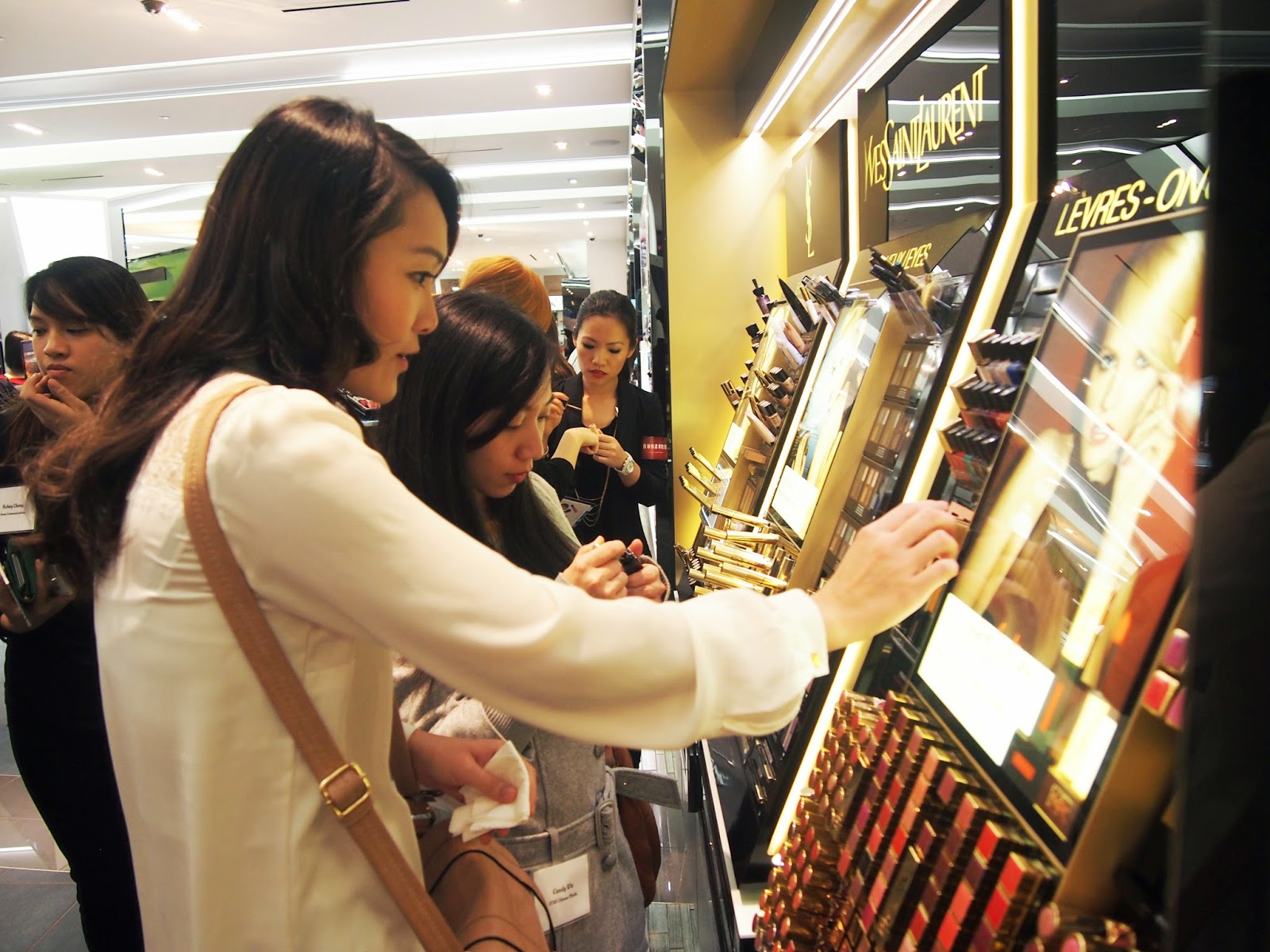
After the workshop, Weibo
beauty bloggers couldn't wait to shop the store for their
favourite brands and products that were demonstrated during the
workshop. Beauty representatives from Lancome, YSL, Shiseido, Clarisonic,
Chanel, Guerlain and Biotherm were also on-site to offer personal consultations
and makeup tips.
Each guest was presented with a $20 Shoppers Drug Mart gift card and an exclusive offer to receive 20,000 Shoppers Optimum bonus points with a purchase of $125 or more. To wrap up the event, attendees received a beautyBOUTIQUE™ gift bag, valued at over $225, filled with samples from over 10 luxury cosmetic brands.

This unique event, targeted at Chinese beauty
consumers, is part of Shoppers Drug Mart’s 2013 Holiday Promotion. Other
elements in the campaign include print, online, indoor OOH, and consist of a major social component.
Monday, 22 April 2013
Sensu is Featured in the Marketing Magazine!
I am glad to announce that Sensu was being
featured in the marketing magazine at the starting of this month! It is the recognition
for our hard work and success, and makes us even more proud of what we do. The article talked about the acculturation differences
of the Chinese compare to the other ethnic groups, characteristics of different
ethnic populations in terms of social network adoption, and the importance of providing
multi-cultural conversations to enhance the effectiveness of customer
engagement.
Sensu has
been using social media and in-language approach to target the Chinese
customers for our clients. Why this approach? A recent data from Internet World Stats
displays of nearly 2 billion internet users estimated in 2010, 82% spoke one of
10 macro-languages, where Chinese is the second most spoken language. According to the analytics from Environics,
it displays that social media adoption is more prevalent for many multicultural
clusters compare to the national rate. Based on the April 2012 report from Mckinsey,
it also showed that 95% of the Chinese internet users are registered on a
social media site. That gives us a reason
to target online social media sites to engage the current and potential
customers for our clients. This way we
could also leverage our competencies in tracking and translating the big data
into measurable insights for clients’ strategic business planning purposes.
A real
business case mentioned by the marketing magazine was on the collaboration between
Holt Renfrew and Sensu, where the Chinese social media site Weibo was used for
the 175 anniversary of Holt Renfrew. The
brand page started as an event based. It
attracted 692 followers in 20 days, and produced an increase of 148% in conversion
rate on Weibo between the years of 2010 to 2012.
According
to the research from Brooking Institution Scholar Homi Kharas, the global
middle class will double in size by 2030, where Asia will account for 64% of
the global middle class. With the continuous
high immigration rate from Asia over the years, these data indicates that the
market will only get larger and larger.
This way the best approach in customer engagement needs to be in place
to correspond to this market change. As of
the future, we would encourage the brands to go above and beyond to take the approach
of understanding your customers, assist them in their preferred languages and embrace
new media for the success in the multi-cultural market.
Thursday, 11 April 2013
Reach Multicultural Consumers Through New Media -- Would You Like to Succeed?
At the end of February, American Marketing Association (Toronto Chapter) hosted a multicultural marketing round-table event. The purpose is to help companies further recognize the potential of the ethnic markets and provide best practices from industry leaders.Here is a video that you can look at, which captures the event and the thoughts of the guests.
The attendees came from four different areas, client, agency, media
and research. The panelist group was comprised of marketing experts including Holt
Renfrew, Beam Global Canada, and Western Union Canada, where both Holt Renfrew
and Beam Global Canada have been working in collaboration with Sensu on
targeting the Chinese consumer segment in Canada.
The panelists each gave examples on how their company successfully utilized
strategies to target the ethnic groups. For
instance, Holt Renfrew leveraged the popular Chinese social media platform,
Sina Weibo, to engage the potential and existing customers. Social media content was culturally tailored to
ensure resonance with the brand among Weibo users. The social media pilot campaign, which focused
around Holt Renfrew’s 175th anniversary, drew more than 700
followers to the brand page within 20 days.
The presenters highlighted the high purchasing power and potential
of the ethnic groups. The combined population
growth of South Asians and Chinese numbered at 27% in the last 10 years. By
comparison, the average Canadian population growth staggered at
only 5 %, which indicating the multicultural market no longer being a niche. Bobby Sahni, the founder and president of
Multicultural 411 and also a veteran in the field, bringing more
than 10 years of experience from leading Rogers’ multicultural marketing
strategy, was the moderator of the event.
He encouraged brands to demonstrate cultural sensitivity and mentioned
that consumers do have cultural preferences when it comes to shopping
behaviours and habits. His piece of
advice is, whether a multi-cultural marketer or just a marketer, it is critical
to recognize the importance of cultural influence and integrate it into the
business strategy to achieve success.
From Sensu’s perspective, by being a sponsor of this event, it is
rewarding to see the increasing interest in multicultural marketing from
mainstream marketers. Authenticity is at
the core of Sensu’s philosophy, and in practicing this through all the work we
do, we believe it is absolutely critical for brands to embrace new media
channels when connecting with Chinese consumers. There are endless opportunities
to connect to the multicultural markets through innovation in media channels –
take a risk, be bold, be creative and it will pay-off. The companies that are willing
to go above and beyond have experienced success. It may seem like a risk on the onset, but it is a calculated risk that brands can take
with the help of experts like Sensu. In
the undeniable reality of diversity in Canada, it is no longer an option for
the future development of all organizations that want to achieve success in the
consumer market.
Feel free to make a comment and tell us what your thoughts are!
Feel free to make a comment and tell us what your thoughts are!
Wednesday, 20 March 2013
How to Make Better Use of Mobile Apps
Happened to have a
conversation with a friend of mine yesterday on the mobile app she downloaded
from a luxury brand. It started off like
this, my friend: “Did you know that this brand had a mobile app?” My reply: “That
is very interesting! I haven’t checked yet, what’s on it?” My Friend: “Actually,
nothing really. See, they just tell you
about their store hours, the locations, the product category that they
have. I was expecting to see some new
arrival or promotional information. This
app is boring. I’m just going to delete it.” Hint! As a brand, have you ever questioned the
effectiveness of engaging your customers through mobile strategies? Or thought of it as a dispensable strategy?
Mobile devices had become the most used
electronics for the daily lives of the younger generation. It is often used for social purposes,
information search, and now it has promptly becoming a tool for shopping
assistance. Many companies have started
to notice this, and are rushing in to share a piece of the pie. Yet, there may be a miss understanding on how
customers could be best engaged through mobile devices. According to the recent research studies, the
two most common reasons that people use mobile devices are for the convenience
and the timely information it provides. By knowing this, a mobile strategy should be
formulated towards these two goals. When
the customers want to be connected to a one stop shop with no time constraints or
geographic barriers, the strategy of developing a store directory app will not
satisfy the objectives. For example, the Facebook app, it contains Check in, Instagram,
Facebook Messenger, and etc. The idea behind it is to go around the user’s life
and target the different aspects of their needs. The fact is the more of user’s time an app consumes
the more successful it is at engaging.
In addition to the functional use of the mobile
apps, it also has the feasibility of translating into research data. As a large corporation, it often can’t go
around to everyone and obtain their thoughts. There certainly won’t always be customers that
are like my friend who takes the initiative to tell me what I wanted to
hear. By monitoring the online data such as the social
media usage, reviews, and the conversations, the marketer’s thoughts on the previous
uncertainties can be better proved. The
path to formulating a customer focused marketing strategy will also be much
less time consuming and less costly.
Wednesday, 13 March 2013
2013 Chinese New Year V.S Canadian Business Practices
Red signs,
couplet, zodiac, and the greeting of “Happy Chinese New Year!” It just makes you feel like you are back in
China again! Other than the local
Chinese, people with different cultural backgrounds are getting involved in
this festival as well. This not merely indicates
that people are valuing the Chinese culture. It is also a smart way of creating new business
opportunities.
This year I have encountered some positives and
not too positive practices on the cultural tie with the Chinese New Year. Something interesting to point out is the
blog post of Yorkdale Mall. Yorkdale organized a selection called the “Year of the Snake Fashion Accessories”. In this selection there are a group of 12
items. It indicated both the 12 zodiac
and the 12 months of the year. These
selections include shoes, glasses, watches, bags and clothing. No
matter what type of accessories one is interest, she would always have an
option for it.
A good try but a bad tie would be misspelling the
year of the snake with the year of the dragon. Many people were tweeting about Sobey’s
New Year’s flyer on the Chinese Twitter site Weibo. A few hundred of retweets were generated on the platform followed by some disappointed comments. It shows the degree of attention this message drove from the Canadian Chinese community. Consider if
it was a positive message spreading out to these many audiences, an association would have been created between the customers and the brand, which is likely to translate into sales figures later on.
This year's Chinese new year has already past. Lesson to learn for the upcoming year is, in order to succeed in marketing to different ethnic groups, creating the right cultural tie is very important. And of course, do the right translations as well.
This year's Chinese new year has already past. Lesson to learn for the upcoming year is, in order to succeed in marketing to different ethnic groups, creating the right cultural tie is very important. And of course, do the right translations as well.
Tuesday, 27 November 2012
17 Chinese miners dug up Canadian xenophobia
There is no secret that Chinese want to live and work in Canada. In fact, nearly 30,000 Chinese migrated to Canada in 2011. However, while it is a tabooed racist topic to rule out visible minorities from immigration list, unions and some Canadians are more willing to jump into the topics “to protect Canada”, ruling out Chinese from doing business in Canada. In 2011, there are 39,825 foreign workers in primary industry, but unions decided that 300 Chinese miners are simply too many. In addition, several deals of Chinese acquisition of Canadian companies are either blocked or significantly delayed by the Canadian government due to political pressure. Opposition to those deals argues that Chinese purchase of Canadian companies will threaten Canadian security and intellectual properties. While few will openly criticize Chinese Canadians, many are jumped into the fray of China bashing: citing pollution, abuses of human rights, greedy, sly, senseless consumption, etc.
While China certainly has a lot of problems, we are talking about real money and real business here. Canadians should be rational and objective to maximize profits and mutual benefits for the good of Canadian public interest and economy. Yet, some Canadians view things very differently when the word “foreign” are replaced by “Chinese”. Somehow, it is a bad deal that Chinese companies buy tar sand mines, while Husky Energy was once owned by the richest man of Hong Kong (still partially owned by his son, Victor Li) and most of tar sand oil will eventually go to the USA, freeing up Gulf supply for East Asia buyers, aka China, at a much cheaper price (largely due to the price difference between Brent Crude Oil Futures (price benchmark of China) and West Texas Intermediate Crude Oil Futures (price benchmark of the USA)). Somehow, it is dangerous for Canadian companies to buy cables and internet equipments from a Chinese company, while most consumer electronics, daily products, toys, apple juice, etc come from China. No one complained when ATI, found by three Chinese Canadians in Markham, Lee Ka Lau, Benny Lau, and Kwok Yuen Ho, are sold to an American company in Sunnyvale, California, AMD, which almost ended Markham high-tech growth overnight. Now, no Canadians worry the lost of intellectual property to China when AMD graphic cards are quietly moved to made in China instead of Canada. Like all good stories, we love to have an antagonist, but crying wolves will just make us look stupid.
Drastic changes to make no change
After months of delay and numerous typhoons from political rumour mills, Xi Jinping, the latest Chinese top leader, has succeeded the presidency with new the military and executive wings. With over 70% turnover rate in both the Central Military Commission and the Executive Committee of the State Council, evidences suggest the internal differences were finally set aside and the settlement was set to make everyone happy (at least, all sides could find quiet compromises.) Aside from normal rhetoric, Xi assures continuity and respect to the previous leaders and emphasis on better the lives of ordinary Chinese. That meant no dramatic u-turn of the macroeconomic policies of suppressing inflation, increasing minimum wages& labour benefits, and achieving both goals through gradual Renminbi appreciation against the USD. With dramatic solutions to the political infighting, the 18th National Congress of the Communist Party of China paves the way to stronger conservatism and patriotism. A new team with new leaders may need more time to act on an economy that shows signs of slowing down. Wealthy Chinese Canadians tend to have over sea assets and businesses in China. The continuation of Renminbi appreciation and suppression of inflation could increase their purchasing power in Canada. Recently, Chinese companies and business owners show signs of increasing interest in investment and migration to Canada. While the leadership swap may be bad news for those who want to seek business opportunities in China, it can be positive news for Canadian market.
Monday, 19 November 2012
Multicultural Marketing: Call for Action in the Malls
Remember a joke that a friend used to make in the past is, “As long as there are people at a place, there are Chinese people.” We used to laugh at it, but we all know that it is the truth. During the past fifteen years, there has been continuous increase of Chinese immigrants all over the world. In the meantime, more and more companies have realized the importance of the Chinese communities both because of their size and the high purchasing power of them.
No need to say, every nationality is different in terms of their habits, life style and preferences. One thing I have realized about Chinese people is that, Chinese people like to go to the malls a lot. Even though their visit might not be directly for the purpose of buying things, it is still a common place for hanging out during their leisure. This phenomenal generally happens in two groups of visitors. One group is the regular visitors, which consist of the elders and nannies that take their children and play in resting areas of the malls. It also consists of teenagers and young adults who like to go for window shopping, and their purpose is usually social or fashion related. The second group of visitors is the tourists. Eaton center specifically, it has been included in many Chinese traveling guide for gift shopping. It is also the most visited mall in Canada throughout the years.
Although Chinese people do have high purchasing power, they have a different value set and ways of buying compare to the others. With these facts, we would expect the malls to have more marketing strategies that directly target at the Chinese customers. However, either my retail working experience in the past or when I was walking in the malls tells me very little about multicultural marketing that has been done for this aspect. One example about how the stores at Paris engage the Chinese customers is that, they try to minimize the language barriers for Chinese at all the tourist shopping areas. Every national brand at these places has at least two to three sales associates that are able to connect to the Chinese customers and sell in Chinese. On the other hand, a large number of the stores at Eaton center have not effectively adopted multicultural marketing as a way of increasing their sales.
Many businesses are now realizing the importance of the Chinese market, yet many stops at the realizing stage. The high volume of Chinese customers should not be kept at the window shopping stage. It is a good time to get customers into the store and convert into sales figures. If these businesses could moving forward and involve multicultural marketing, it will create a bridge for effectively approaching and engaging the Chinese customers for future sales.
Monday, 22 October 2012
China is the future? Hollywood hints it is....
Has anyone noticed that there is an increasing display of Asian aspirational elements in all things that are supposedly Western? Take the example of Hollywood blockbuster, "The Looper", which I had decided to watch based on my interest of time travel - but boy, did something else stand out to me. Yes, the appearance of Qing Xu as Bruce Willis' wife was a nice bonus but it was something else - a particular line which developed "China as the future" as an important theme of the movie.
So for this who didn't watch the movie yet and plan to, please note there are some slight spoilers in the rest of the post to follow - don't say I didn't warn you!
Young Joe (Joseph Gordon Levitt) is a looper - which is the name for killers who lived 30 years into the past and killed their target, who are people of the future sent back to the past through time travel, to be killed.
One of the scenes mark Young Joe having a conversation with his manager, Abe (Jeff Daniels), who is a man of the future sent back to the past to keep a watch over the Loopers. Abe tells Young Joe that he knows he has been storing his silver and learning French in preparation to escape the city. He then probes to ask Young Joe "Why French?" and was responded with "... I'm going to France." (At this next moment, the critical line comes in which sets the context for the rest of the storyline.) Abe twitches his face and stares at Young Joe in the eye and says "Go to China. I'm from the future. Trust me, go to China."
It is quite evident that "China as the future" is an important theme for the entire movie as the later half of the movie does show Old Joe (Bruce Willis) in Shanghai, China where he meets his beloved wife, Summer (Qing Xu). The death of his wife was also critical to the character development of Old Joe and establishes his motivations to go back into the past in hopes to save Summer.
It is also interesting to note that the movie Looper is actually an US/China cooperation and that two editions of the movie were released, one for the US market and one for the Chinese market. The Chinese version (still in English with Chinese subtitles) contained many more scenes shot in Shanghai and also shows Bruce Willis speaking a few lines in Mandarin. This was seemingly done to appeal to the Chinese audience as these scenes were cut from the US edition.
How does this all relate to multicultural marketing? As Sensu also always believes, it is the future. In short, products and brands who are able to appeal to more than one market audience will see better success than those who do not. Multicultural marketing is merely just a scaled form of global marketing in a local context. I am sure many of us Chinese in Canada (especially those immigrants who proudly come from Shanghai!) would have loved to see more of the exclusive scenes shots in Shanghai - why cut them out?!
Cheers!
So for this who didn't watch the movie yet and plan to, please note there are some slight spoilers in the rest of the post to follow - don't say I didn't warn you!
Young Joe (Joseph Gordon Levitt) is a looper - which is the name for killers who lived 30 years into the past and killed their target, who are people of the future sent back to the past through time travel, to be killed.
One of the scenes mark Young Joe having a conversation with his manager, Abe (Jeff Daniels), who is a man of the future sent back to the past to keep a watch over the Loopers. Abe tells Young Joe that he knows he has been storing his silver and learning French in preparation to escape the city. He then probes to ask Young Joe "Why French?" and was responded with "... I'm going to France." (At this next moment, the critical line comes in which sets the context for the rest of the storyline.) Abe twitches his face and stares at Young Joe in the eye and says "Go to China. I'm from the future. Trust me, go to China."
It is quite evident that "China as the future" is an important theme for the entire movie as the later half of the movie does show Old Joe (Bruce Willis) in Shanghai, China where he meets his beloved wife, Summer (Qing Xu). The death of his wife was also critical to the character development of Old Joe and establishes his motivations to go back into the past in hopes to save Summer.
It is also interesting to note that the movie Looper is actually an US/China cooperation and that two editions of the movie were released, one for the US market and one for the Chinese market. The Chinese version (still in English with Chinese subtitles) contained many more scenes shot in Shanghai and also shows Bruce Willis speaking a few lines in Mandarin. This was seemingly done to appeal to the Chinese audience as these scenes were cut from the US edition.
How does this all relate to multicultural marketing? As Sensu also always believes, it is the future. In short, products and brands who are able to appeal to more than one market audience will see better success than those who do not. Multicultural marketing is merely just a scaled form of global marketing in a local context. I am sure many of us Chinese in Canada (especially those immigrants who proudly come from Shanghai!) would have loved to see more of the exclusive scenes shots in Shanghai - why cut them out?!
Cheers!
Sunday, 7 October 2012
Celebrating China’s National Day Holiday in Canada
This past week is China’ s National Day
Holiday, which allows for 7 days off and usually is called “Golden Week”.
Chinese people go out for eating, travelling and shopping during these days.
When my media friend told me there would be
a flag-raising ceremony at the Markham Civic Centre on the afternoon of October
1st, I didn’t realize she was talking about raising China flag until
I was physically there with her.
It was amazing to see people with different
ethnicity carry both China flag and Canada flag on a Chinese occasion at a
Canadian government office. As this year’s Mid-Autumn Festival was one day
before, there were moon cakes as sweet treat.
The ceremony was initiated by Federation of
Chinese Canadian in Markham, a not-for-profit organization dedicated to the
provision of services to the Chinese community and the integration of Chinese
Canadians into the mainstream of Canada since 1989, and supported by Frank Scarpitti, the mayor of the city of Markham. The mayor said during the ceremony: ”It’s a symbol of
respect for those who come here from that part of the world.”
Later, I knew the same celebration
ceremonies were held in Richmond Hill and Pickering as well. As the second
largest ethnic group in GTA, Chinese has increasing strong influence almost
everywhere. It is great to know the influence has gained attention and recognition
from retailers, CPG and even government in Canada.
Tuesday, 24 July 2012
Why the Houston Rockets Made an
Excellent Acquisition
The Houston Rockets may have acquired one of the most valuable players in the NBA, and at an extremely low cost in comparison to the deal. Jeremy Lin will be playing for the Rockets for the next 3 years for a mere $25 million. Excellent Acquisition
The American born NBA player of Taiwanese decent, undrafted out of Harvard has managed to climb above most players in terms of salary within the NBA; and he has achieved this feat through playing less than one full season of games within the NBA.
Logically, scepticism surrounding the Rockets' offer to Lin has been justified. Many journalists, sports columnists and sports fanatics were stunned by the Rocket's offer and supported the New York Knicks decision of letting Lin walk away. However, critics have disregarded the crucial fact that like all other professional sports organizations, when it comes down to it, the Houston Rockets is just another business. Brand awareness, ticket sales, and market share are just some of the factors that fixate the attention of CEOs of major corporations and franchises. Every decision, every tactic must in some way, present a significant return on investment – and Lin can provide a ROI in many more ways than just through winning basketball games.
Logically, scepticism surrounding the Rockets' offer to Lin has been justified. Many journalists, sports columnists and sports fanatics were stunned by the Rocket's offer and supported the New York Knicks decision of letting Lin walk away. However, critics have disregarded the crucial fact that like all other professional sports organizations, when it comes down to it, the Houston Rockets is just another business. Brand awareness, ticket sales, and market share are just some of the factors that fixate the attention of CEOs of major corporations and franchises. Every decision, every tactic must in some way, present a significant return on investment – and Lin can provide a ROI in many more ways than just through winning basketball games.
Lin captured the hearts of America with his story. He excels both academically, and athletically. He is faithful to his religious values and beliefs. He had to put in hard work for his results and stepped up to exceed every single person's expectations when he was given his opportunity starting February 4th 2012. In a matter of 14 days, the resale of Knicks ticket prices increased by 300% on the market and an 87% increase in television ratings on the MSG network. These are all assets that the Houston Rockets can be guaranteed. But there's more – much more.
Last June, Yao Ming announced his retirement from the NBA. Although this did not come as a surprise to the dedicated fans of the Chinese NBA superstar, there was a big space to fill and Lin is the man for the job. Yao's legacy has proved far more than the fact that Chinese people can play basketball; it set the tone for the NBA's outreach across Asia. Jeremy Lin is now the biggest face in the NBA for the Asian basketball community. He was not born in China but it does not matter. He has the values and work ethics that are admired within the Chinese culture. Additionally, Lin has already gained support abroad, especially amongst the 22 million people in Taiwan. Lin can be the man to connect the Chinese basketball fans to the NBA, and more importantly, to the Houston Rockets once again. A player with that potential is priceless
There is a huge market within the Asian basketball market. Regardless of whether people want to admit it or not, the potential surrounding Lin is worth far more than $8.33 million for the next 3 years. The Rockets were insightful enough to make sure he's playing on their court this coming fall.
Monday, 16 July 2012
Night It Up 2012: The Celebration and Showcase of East Asian Culture
Night It Up 2012
It was the
"Asian night market" that had everyone talking. Night It Up has, once again, successfully showcased the East Asian community around the GTA over the
past weekend. Organized by the Power Unit Youth Organization, a non-profit
youth empowerment and development group comprised of volunteers, the team
assembled a display of pop-cultural performances and authentic Asian street
food.
What exactly,
may you ask, attracted more than one hundred thousand people to this venue in
the Town of Markham?
Was it the sounds
of multicultural performances from talented young singers, bands and dance
groups?
Was it the selection
of over 100 food vendors representing Taiwan, Hong Kong, and many other parts
of East Asia, or the distinct aroma of stinky tofu from one specific cart?
Maybe it was
even through word of mouth that there were muscular men at the
"Trojan" sponsorship booth - willing to take pictures.
All of these features may have been a part of
the reason, but the sense of community among the East Asian within the GTA was
definitely the deciding factor.
Night It Up
offers the experience to gather and celebrate each others' East Asian culture. There
is a sense of pride when coming together to embrace our common backgrounds,
values and interests.
There is a
sense of comfort when walking around the night market venue and sipping fresh
watermelon and pineapple juice straight out of the fruit with family and
friends.
There is a
sense of appreciation when taking the time to be immersed in one's own
traditions, even for a few hours, while having the utmost respect for the multiculturalism
in Toronto.
Just like
Toronto's annual Caribana, this night market allowed the acknowledgement and
celebration of an unique culture - and this opportunity was certainly not
overlooked. The physical presence and high spirits among the East Asian
community at Night It Up 2012 were overwhelming!
Monday, 18 June 2012
Nestle - Adaptations to the Global Market & Exposing Market Opportunities
Nestle - Adaptations to the
Global Market &
Exposing Market Opportunities
Exposing Market Opportunities
What is
the competitive advantage? Derived from this question is the single most
important factor that to any business model. However, what might have been
prosperous and successful two years ago might not be the case today. The global
marketplace is constantly changing; with it, the needs and desires of consumers
are rapidly evolving as well. Companies
who adapt through refreshing innovations will emerge or continue their
dominance while the less flexible will fall.
To
further toss up the implications, not all cultures within the vast geographical
regions are the same. This might not oppose a threat to a local business who
operates under one municipality, but can be a huge road block for
multi-national companies as they have to consider different strategies, for the
different environments. Nestle, the world's largest health food company, is a
prime example of doing things right - within the baby formula market anyways.
China's
market demand can never be simplified in one piece of publication. However,
there are unique features worth noting. With the one child policy enforced in
most urban cities, parents value their child as top their priority and this
starts from day one. Chinese parents
spend as much as they can on their one and only child; they try to provide the
best within, and sometimes outside of their capabilities. Like a business,
capital is invested, intangibles are nurtured and competitive inputs are
exhausted from resources all in hopes of a future return on investment.
In the
western society, parents are comforted by the safety of the nutritional foods
their babies consume. Baby formulas must be 100% safe and limited trust is
displaced on any brand when it comes to checking the credibility and sources.
However, many Chinese consumers equate the quality of the product, with the
name of the brand. Instead, they are looking for other "upper hands"
when purchasing baby formula. Formulas rich in DHA & RHA fatty acids, Omega
3 and Omega 6; formulas that will increase brain development from the earliest
age possible.
An
overwhelming majority of Chinese parents would not mind paying 150% the price
for those added ingredients and commercialized claims and Nestle recognizes
this market opportunity. In April 2012, Nestle acquired the baby food unit
Pfizer for $11.9 billion USD. Why? Because this specialized company is
pharmaceutically capable of enhancing product development through added
nutritions that parents want to see. These strengths give Nestle the power to
attract emerging markets while maintaining their reliable reputation
domestically.
Nestle
understands and exposes the values of the various countries in which they
operate under; they do not fail in making the right moves to advance in the
ever-changing global market. China has been a primary target throughout the
years and those initiatives, as a return, have paid off substantially.
Sunday, 3 June 2012
The Value Beneath Haggling
Reaching a good deal when it comes to making a purchase is always preferable within every
individual; who would rather pay full price, as oppose to enjoy the benefits of having the same item
when it's 30% off? This simple concept however, whether we are aware or not, goes much further in the
minds of a Chinese consumer. Shadowed by the Chinese social-economic goals and mentalities of
chasing superiority, achieving the greatest success, and ultimately winning, there is definitely a set of
unique cultural values created.
It is rooted deeply within our intuition to beat the system - this concept is the same when
consuming. There is a lack of satisfaction until we can "beat the system," and the value cannot be
optimized until we do.
In the same way how individuals communicate their persona through various forms of art and
creative writing, Chinese consumers also have different methods of expressing this intuitive desire.
In a Chinese oriented environment, those who are aggressive will haggle ferociously with the in-
store owner for a deal that would seem to be unable to meet gross margins and unfathomable to
Westerners. Pooling together the strategic knowledge of these seemingly relentless hagglers would be
enough to publish a hefty book! On the other hand, the more passive Chinese consumer will constantly
browse online catalogues, search for sales on blogs and social media channels, and compare the prices
until they feel that they have found an exclusive and superior deal. This pattern is omnipresent from
purchasing clothing, to having their tires changed at an auto shop.
Realistically, the efforts spent only translates to savings of 5% to 10% on the lowest price a
retailer is willing to go. However, the hidden value within these transactions is a sense of
accomplishment. The accomplishment that one has successfully achieved the best deal that not many
other people could achieve and it is not enough to have a discount directly presented to the Chinese
consumer. When this occurs, there is an excitement since the consumers' intuitive desires are fulfilled
and this will create a positive impression on the serving businesses' image.
As many people know, the key to successfully reaching out to consumers is knowing their
values. However, values aren't always universal and globalization is always adding complexity to this
assessment. How are you going to adapt?
Tuesday, 15 May 2012
Canada May Expect More Chinese Students
It always makes me feel home once I land in Shanghai. Because of its attractiveness in terms of economic environment, business opportunities, fashion attitude and convenient lifestyle, Shanghai has become destination for non-Shanghainese and even non-Chinese. Not surprised to hear that population in Shanghai has exceeded 22 Million. I can tell from crowdedness in each subway line in non-rush hours.
I met a lot of friends during my 4-week stay in Shanghai in April. Most of them are middle-class and some of them are in higher status. The common concern for them is the future of China. Given the problems of pollution, government corruption, political system, unsafe food and social unrest, they are concerned about their future and their next generation’s.
As most of you may be aware, education is top priority for every Chinese family. Especially, “one child policy” makes parents put 100% hope on the only child. Some of them decide to go to US to give birth for their kids. It costs more than C$30,000 but they think it worthwhile as their kids obtain US passport.
On one hand, most Chinese save more than spend; on the other hand, when it turns to education for kids, they spare every effort to support. The mentality for Chinese in consumption is price equals to quality; therefore, they prepare for paying premium for better school environment, more experienced teachers and more advanced methodology. The private school in Shanghai charges more than C$12,000 per year (from kindergarten), which is almost the same tuition in Canada.
North America is always the first choice for overseas study. Canada stands out due to its favorable policy (3-year open work visa after graduation), neutral political standing and its diversity. Chinese families have realized the earlier children accept overseas education, the better. As immigration raised the bar, those parents may not get chance to come to Canada as immigrants and they don’t feel comfortable to leave children when they are too little. The line draws at the age of 15 (Grade 9 or 10). And that’s why they prefer boarding schools.
I came back with the request from my friends (children age between 1 and 12): to find out how to apply for private schools in Toronto/Canada. I suppose Canada may expect more Chinese students in the coming years.
Tuesday, 8 May 2012
Immigration Key to Canada's Future
http://www.theglobeandmail.com/news/national/time-to-lead/
Globe and Mail ongoing series and discussions on issues that matter most to Canadians has chosen the topic of immigration and explores into its importance to Canadian future. Well for starters, here are a few key "facts and figures" (derived from throughout various articles from the ongoing series):
- Between now and 2021, a million jobs are expected to go unfilled across Canada
- When immigrants arrive, they not only fill gaps in the work force but pay taxes and spend money on housing, transport and consumer goods
- Studies show that their offspring tend to be among the country's best-educated and initiative-taking young people
- Today, there are 4.2 working-aged Canadians for every senior citizen, making contributions to cover retirees' pensions and health care. By 2031, that ratio will be cut in half. The tax base will shrink, growth will slow and labour shortages will become even more dire
- Within two decades, barring an improbable baby boom, immigration will account for all population growth
- With 34 million people, this country remains highly underpopulated, for all its vast geography
- Recent immigrants earn only about 60 per cent as much as the Canadian-born
- Among those in their prime working years, immigrants are nearly 60 per cent more likely to have a university degree than those born here (37 per cent compared with 22)
Since launching the focus series just yesterday, there has been a multitude of the comments from the general public. Not surprisingly, the question is placed on the keyword: multiculturalism - is it good or bad for Canada?
As a new breed multicultural marketer myself, how can I possibly not share my views as I stick glued to my screen on all the latest comments that are coming in. But there is one thing that is really pestering me. As a second generation Chinese Canadian, I never really understood why there is a concept that insists on the importance for immigrants/visible minorities to fully assimilate into Canadian culture. The article nails it spot on when they say that our nation's greatest challenge is to understand and embrace the ways immigrants will reshape this country. Integration and not assimilation is the key to social harmony to land of multicultural ethnicities - no one should have to be coerced into giving up their home country culture in order to have the rights to be fully entitled to to enjoy the beauty of being a part of Canada.
For crying out loud, I was born here and I really, most genuinely do not know how to answer what "Canadian culture" means. I've been saying this since I've had the intellectual capacity to think on my own, "Being Canadian is great, because the people here embrace me for who I am" There is no greater place in the world to be a Chinese person than in Canada, and I mean that sincerely from the bottom of my heart. It is due to this very reason that drives my passion for multicultural marketing, particular with the focus on the Chinese segment.
Unfortunately, my appreciation for Canadian diversity on the social front is not always consistently reflected in our workplace and Corporate setting. To raise an example, today I was at a corporate networking event for a prestige book launch in Downtown Toronto, I just really can't help but notice that I, along with the my group, were among the only Chinese face in the crowd of senior level executives. So...in the face of a "looming labour shortage and improbable baby boom", is this how our Canadian businesses respond?
Perhaps I shall end this blog post with on slightly more positive and hopeful note:
“We're losing the idea of building the country.” Prof. Studin argues that the country should set its sights on swelling to as many as 100 million people. This new Canada would become a far more influential consumer market, a more diverse and imaginative producer and a much more robust and self-sustaining culture. Its voice would become more prominent in international affairs.
Cheers to Canada's future!
Sunday, 1 April 2012
No need for a 2D-glasses for the movie, but maybe one for the word "acculturation"?
It is not big news that latest Chinese movie are entering Canadian theatres nowadays, especially when living in Toronto - I always found myself studying Chinese movie posters on TTC subway and thinking with a smile on my face, "This feels just like home".
Missed seeing The Viral Factor starring Jay Chou and Nicholas Tse just a couple of months ago, I was determined to join the release madness of "Love in the Buff" (the sequel of "Love in a Puff") when press announced that its premier in North America would occur on the last day of March.
Jumped out of the plane which just took me back from Chicago, me and my friends quickly gathered at the nearest AMC, looking forward to a completely Chinese movie night out experience.

The theatre was packed up with a rather long line of Chinese youngsters waiting to enter. Most of them were conversing in Cantonese or English, sharing some jokes from "Love in a Puff", or checking out Weibo and Facebook on iPhone. Again, this resemblance of how such social setting looks like Hong Kong brought me a sense of nostalgia as well as familiarity.
During the movie, you can hear laughter at the most Cantonese jokes and slangs, claps at the funny mimics of old pop culture from the 80s, and whispers about actors gossip. All these things were happening there in a western movie theatre far away from China, when hundreds of people sharing their strong and joyful attachment with their Chinese culture. Can they speak English? Absolutely, maybe even half of this group even reckon English as their first language. They spent a few years or even most parts of their life in Canada, they study or work in Canadian environments, they greatly enjoy western food and cultural activities, but all these doesn't affect how they feel about their own Chinese culture - whether its origin traces back to Hong Kong, Mainland, Taiwan, Fujian, etc.
For immigrants, it is a re-socialization process for all when entering a completely different culture from their original one. For some Canadian born Chinese, it is also an on-going acculturation process when one finds him/herself to some extend attached to the Chinese culture when being exposed to from an early age. Does the concept "acculturation", therefore, worth a second look when it is easily mistaken as a substituent term for "assimilation"? Should it be solely examined based on one's level of adaptation to the host country culture (ie. Canadian culture)? What is the alternative two-dimentional way to look at it?
Missed seeing The Viral Factor starring Jay Chou and Nicholas Tse just a couple of months ago, I was determined to join the release madness of "Love in the Buff" (the sequel of "Love in a Puff") when press announced that its premier in North America would occur on the last day of March.
Jumped out of the plane which just took me back from Chicago, me and my friends quickly gathered at the nearest AMC, looking forward to a completely Chinese movie night out experience.

The theatre was packed up with a rather long line of Chinese youngsters waiting to enter. Most of them were conversing in Cantonese or English, sharing some jokes from "Love in a Puff", or checking out Weibo and Facebook on iPhone. Again, this resemblance of how such social setting looks like Hong Kong brought me a sense of nostalgia as well as familiarity.
During the movie, you can hear laughter at the most Cantonese jokes and slangs, claps at the funny mimics of old pop culture from the 80s, and whispers about actors gossip. All these things were happening there in a western movie theatre far away from China, when hundreds of people sharing their strong and joyful attachment with their Chinese culture. Can they speak English? Absolutely, maybe even half of this group even reckon English as their first language. They spent a few years or even most parts of their life in Canada, they study or work in Canadian environments, they greatly enjoy western food and cultural activities, but all these doesn't affect how they feel about their own Chinese culture - whether its origin traces back to Hong Kong, Mainland, Taiwan, Fujian, etc.
For immigrants, it is a re-socialization process for all when entering a completely different culture from their original one. For some Canadian born Chinese, it is also an on-going acculturation process when one finds him/herself to some extend attached to the Chinese culture when being exposed to from an early age. Does the concept "acculturation", therefore, worth a second look when it is easily mistaken as a substituent term for "assimilation"? Should it be solely examined based on one's level of adaptation to the host country culture (ie. Canadian culture)? What is the alternative two-dimentional way to look at it?
Saturday, 24 March 2012
Hong Kong's 2012 Chief Executive Election
Today marks the day where Hong Kong is in the process of electing for a new Chief Executive to govern over the next five years. Most of the Hong Kong Chinese community, both locally in Hong Kong as well as here in Canada have been very tapped into recent news of the candidates.
There has been ongoing debate about the future of Hong Kong and how much of its "one country, two system" structure will be kept in the years to come. There has been rumours and opinions that China's central government has been intervening and exerting pressure on the elective council, a body of professionals and individuals who are eligible to cast their vote for the next Chief Executive.
It is pertinent for multicultural marketers to understand not only the purchase behaviours of Chinese consumers but also to understand the political landscape on the macro level. Brands wishing to target this community needs to understand the importance of China's historical and modern day government structure in order to genuinely understand the factors that influence and ultimately drive consumer ideologies and behaviours.
In the next blog post, I'll explore more in depth into the political landscape of China, how it shapes consumer values and ultimately drive consumption preferences. Moreover, we'll look into how to leverage this understanding to target the ethnic Chinese consumer here in Canada.
There has been ongoing debate about the future of Hong Kong and how much of its "one country, two system" structure will be kept in the years to come. There has been rumours and opinions that China's central government has been intervening and exerting pressure on the elective council, a body of professionals and individuals who are eligible to cast their vote for the next Chief Executive.
It is pertinent for multicultural marketers to understand not only the purchase behaviours of Chinese consumers but also to understand the political landscape on the macro level. Brands wishing to target this community needs to understand the importance of China's historical and modern day government structure in order to genuinely understand the factors that influence and ultimately drive consumer ideologies and behaviours.
In the next blog post, I'll explore more in depth into the political landscape of China, how it shapes consumer values and ultimately drive consumption preferences. Moreover, we'll look into how to leverage this understanding to target the ethnic Chinese consumer here in Canada.
Subscribe to:
Posts (Atom)